

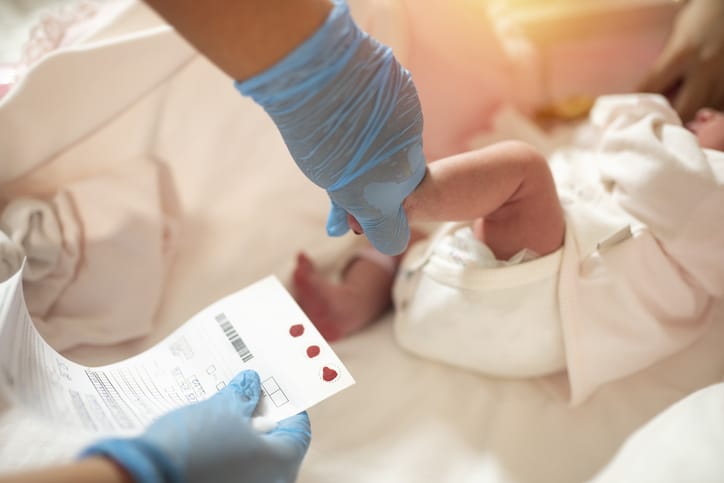
In newborns suspected of fetal and neonatal alloimmune thrombocytopenia (FNAITFetal and neonatal alloimmune thrombocytopenia A rare condition in which a mother’s immune system attacks fetal platelets, leading to dangerously low platelet levels before and/or after birth.), blood analysis plays an important role in guiding treatment, monitoring the evolution of the condition and confirming diagnosis.
A complete picture is obtained by measuring the newborn’s platelets, red blood cells and white blood cells. This information is then used as a baseline throughout treatment to assess progress and recovery.
Blood tests for newborns suspected of FNAIT
When a newborn presents with symptoms such as pinpricks (petechiae) or patches of bruising (purpura) under the skin, lethargy, irritability, unexplained bleeding and hematomas, FNAIT will likely be suspected. Urgent imaging to check for internal bleedingFetal hemorrhage Any bleeding that occurs before birth. In FNAIT, this usually results from extremely low platelet counts. on the brain, lungs or gastrointestinal system may be required, and a blood sample may also be taken.
A full blood count that measures platelets count, as well as the number of white and red blood cells in the body is urgently required if FNAIT symptoms are visible. The key information for doctors at this stage will include:
The platelet countPlatelet count A measure of how many platelets are in the blood. FNAIT is characterized by severely reduced counts in a fetus or newborn.: This is the most important test and will provide a baseline for doctors to refer to throughout treatment to assess its effectiveness and the recovery of the newborn. A normal platelet count for newborns is 150,000–350,000 per microliter (µL). In FNAIT, counts can fall below 100,000/µL in mild cases or below 30,000/µL in severe cases. The platelet levels will then be monitored continuously, with tests every 12 to 24 hours. An urgent platelet transfusionPlatelet transfusion A treatment for newborns with very low platelet counts that ideally uses HPA-compatible or washed maternal platelets. is likely to be recommended as the first step in treating thrombocytopeniaThrombocytopenia A platelet count that is lower than normal..
Hemoglobin and hematocrit: Red blood counts are important to measure, to understand if there has been bleeding before or during birth. Low levels of hemoglobin and hematocrit will indicate blood loss, and this may be related to low platelet levels as blood loses its capacity to clot. Anemia may result and lead to complications such as intracranial hemorrhageBrain bleed Bleeding inside the fetal brain, also known as an intracranial hemorrhage. In FNAIT, it's often caused by severe thrombocytopenia and can lead to long-term disability or death. and reduced oxygen flow. A red blood cell transfusion may be deemed necessary.
White blood cell count: This checks for an infection in the newborn. In some cases, low platelets can be due to other conditions such as preeclampsia in the mother, a blood infection, toxoplasmosis, rubella, cytomegalovirus or herpes. Testing of white blood cell counts when FNAIT is suspected will rule out infection or inflammation.
HPA genotyping: In parallel to the blood samples taken from the mother and father for HPAHuman platelet antigen Proteins found on the surface of platelets. Incompatibility between maternal and fetal human platelet antigens can trigger FNAIT. genotypingGenotyping A laboratory test that identifies which platelet antigens a person carries. Often used to confirm HPA incompatibility and assess recurrence risk., a blood sample is taken from the newborn for neonatal HPA genotyping.
Diagnosing FNAIT
When FNAIT is suspected, treatment is immediately started without waiting for confirmation of a FNAIT diagnosis. However, it is important to pursue diagnostic testing to better understand the condition, its effect on the newborn and importantly, to guide care and potential treatment during future pregnancies.
Sign up here to get the latest news, perspectives, and information about FNAIT sent directly to your inbox. Registration is free and only takes a minute.