

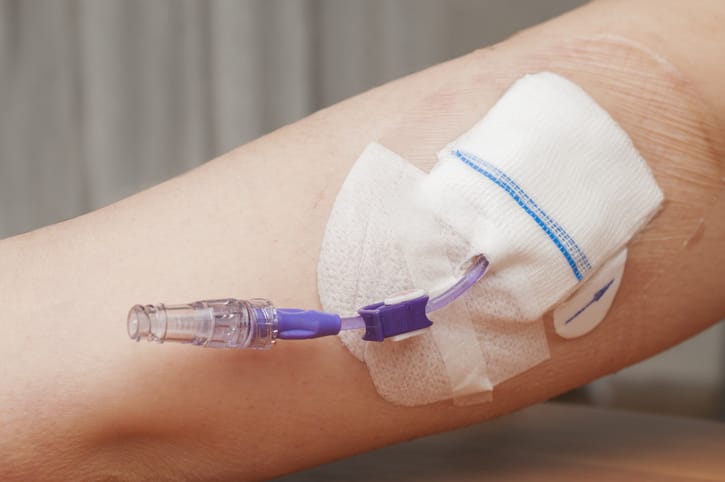
A peripherally inserted central catheter, also known as a PICC, is a thin, flexible tube inserted into a vein in the arm and threaded into a large vein near the heart.
Newborns with fetal and neonatal alloimmune thrombocytopenia (FNAIT) typically have one fitted soon after birth to allow doctors to administer intravenous immunoglobulins (IVIG) with ease.
A vehicle for drug administration
Whenever doctors need to give a patient intravenous medication, they first need to gain venous access. You may have had the experience of having blood drawn from your arm. The doctor first finds a vein that is later used to insert a needle to draw blood.
Imagine if you need to be administered certain drugs through venous access and that this process needs to be carried out multiple times a day. It would be very uncomfortable for you if the doctor had to find a vein and insert a needle each time. Furthermore, veins that have had needles repeatedly stuck into them tend to collapse, or the surrounding tissue may bruise, making it more challenging to gain venous access the next time.
Read more about FNAIT testing and diagnosis
If drawing blood/administering intravenous drugs is difficult for an adult, imagine how uncomfortable it must be for infants, who have tiny veins that make venous access even more difficult.
A PICC solves this problem. It is inserted into a vein (typically a large vein in the upper arm), and because it is a long tube, it can be guided to be connected directly to the vein closest to the heart.
Benefits of a PICC
Aside from saving the infant the pain and discomfort of having a needle repeatedly inserted into a vein whenever venous access is necessary, a PICC has other major benefits that ultimately make it easier for doctors to do their jobs.
One of the most important features of PICCs is that they can remain in place for an extended period of time, for weeks or for months if necessary. During this time, doctors may freely administer the patient intravenous fluids or drugs, such as IVIG, which is often necessary in FNAIT.
In addition, PICCs usually have more than one lumen, meaning that doctors can administer multiple fluids or drugs at the same time. This is important for patients who require more than one intravenous therapy.
With a PICC in place, doctors do not have to worry about the potential complications of repeated venepunctures, which as mentioned can cause bleeding and bruising.
Another benefit of a PICC is that they can potentially be used to administer intravenous medications at home, provided that the treating doctor thinks that it is both appropriate and safe. Home administration of drugs such as IVIG may be performed at home with medical supervision.
PICCs are a convenient way to gain venous access at a time in a child’s life during which intravenous medications need to be repeatedly administered. PICCs minimize pain/discomfort and are a relatively safe way to gain long-term intravenous access.
Sign up here to get the latest news, perspectives, and information about FNAIT sent directly to your inbox. Registration is free and only takes a minute.